Expansion Is Earned Before It's Sold
Expansion targets quietly turned CSMs into quota carriers — and customers feel it. The four preconditions that make an expansion conversation legitimate, and the one-page readiness map that gates the pitch until they are true.
The fastest way to damage a healthy account is to pitch expansion before the customer has felt the value of what they already bought. Expansion isn't a sales motion bolted onto CS — it's the natural result of an account that's already winning, and the job is to recognize when that's true, not to manufacture it on a quota timeline.
Somewhere in the last few years, "expansion" became a CS responsibility, and with it came a quiet distortion. CSMs got expansion targets. Expansion targets created pressure to generate expansion. And pressure to generate expansion produced a lot of CSMs pitching upsells to customers who hadn't yet succeeded with the thing they originally bought. This is the most reliable way I know to take a recoverable account and make it cynical.
The reframe that fixes it is simple to say and hard to live: expansion is earned before it's sold. It is a lagging indicator of an account that's already healthy, not a lever you pull to make an account healthy. When you treat it as a lever, you invert the relationship — you ask the customer to give you more before you've given them what they paid for — and sophisticated buyers feel the inversion immediately. They don't experience it as partnership. They experience it as a vendor with a quota.
The four preconditions
Before any expansion conversation earns the right to happen, four things have to be true. Not three. The missing one is usually the reason the expansion stalls or, worse, lands and then churns.
A proven outcome on the original purchase. The customer must have already gotten the value they bought the first time. This is non-negotiable and it's the one people skip under quota pressure. Expanding an account that hasn't realized initial value isn't expansion — it's increasing your exposure to a churn that's already forming. You're enlarging the crater.
A multithreaded relationship. Expansion almost always crosses a boundary — a new team, a new use case, a bigger budget line — and that means new stakeholders. If your entire relationship runs through one champion, you can't expand; you can only ask that one champion to do all the internal selling for you, which they won't, because it's not their job. The breadth of your relationship is the ceiling on the size of your expansion.
Budget visibility. You have to know where the money for expansion would come from before you propose it. Is it in the champion's discretionary budget, or does it require a different buyer and a different approval cycle? An expansion that's a casual yes for your champion and a six-month procurement ordeal in reality isn't an opportunity — it's a forecast you're about to get wrong. Knowing the funding path is the difference between an expansion you can call and one you're hoping for.
An unmet adjacent need the customer actually feels. Not a need you've identified for them — a need they feel. There's a vast difference between "I can see how Module B would help this customer" and "the customer has told me, in their words, about the problem Module B solves." The first is a pitch. The second is a pull. Expansion that comes from pull renews; expansion you talked them into churns at the next renewal when the champion who indulged you is reviewing line items.
The artifact
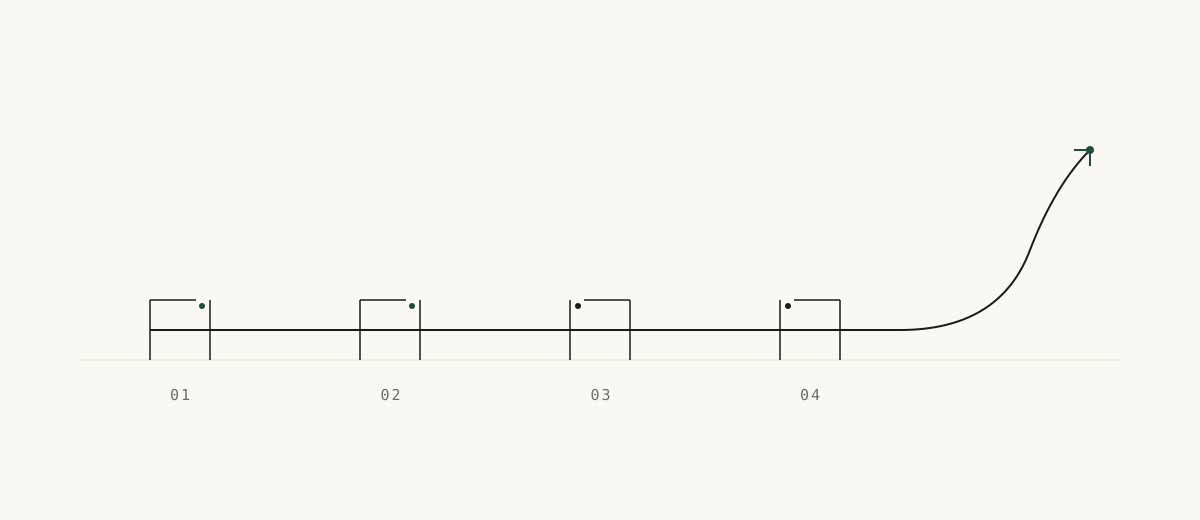
The Expansion Readiness Map. A one-page diagnostic that scores an account on the four preconditions — proven outcome, multithreaded relationship, budget visibility, unmet adjacent need felt by the customer — with a simple gate: until at least the first two are solidly true, the recommended action isn't "pitch expansion," it's the specific account work that would make them true. It's designed to sit in your account-planning rhythm and act as a brake on quota-driven premature pitching, redirecting that energy into the work that actually produces expansion downstream.
Scoring the map
Each precondition gets a 1–4 score. The anchors matter more than the number — a 4 should be defensible to someone who wasn't in the room.
| Precondition | What a 4 looks like | What a 1 looks like |
|---|---|---|
| Proven outcome | Customer states the outcome in their words, with numbers they produced | Value story exists only in your QBR deck |
| Multithreaded relationship | Named, active contacts on the team the expansion touches | Everything routes through one champion |
| Budget visibility | You know the budget line, the buyer, and the approval cycle | "Our champion seems confident" |
| Adjacent need | Customer has described the problem unprompted, more than once | You inferred the need from usage data |
Two rules turn the scores into a decision:
The gate. Preconditions one and two are the gate. Until proven outcome and multithreading both score a 3 or better, the recommended action is never "pitch expansion" — it is the specific account work that moves those two scores. Pitching through the gate doesn't accelerate the expansion; it converts it into renewal risk.
The call. Once the gate is passed, add all four scores. Fourteen or better with nothing below a 2: propose this quarter, and put it in the forecast. Eleven to thirteen: run the play that raises the lowest score, then re-score next month. Ten or below: the need probably isn't real yet — park it and stop spending motion on it.
What this changes on Monday
Run the map against your top ten accounts. It takes about an hour, and most of that hour is admitting what you don't know — which budget line the money would come from, whether the need is felt or inferred. The blanks are the diagnostic.
Expect two or three accounts to clear the gate. That's not a failure of the portfolio; that's the map doing its job. The other seven get something more valuable than a pitch: one named piece of account work each — an outcome review that produces the customer's numbers, an introduction that adds a second thread, a question that surfaces the funding path.
The quota pressure doesn't go away. The map just points it somewhere that compounds. Expansion pipeline built from readiness-mapped accounts is pipeline you can defend line by line when the CRO asks what's real — because every entry comes with the evidence attached.
This piece opens the Expansion & Multithreading pillar. The readiness map follows the same discipline as the Renewal Forecast rubrics: scores you can defend, gates you don't argue with. If it was useful, The NRR Playbook sends one tactical idea like this every week.